

Every single morning across the UK, administrative teams in general practice sit down to perform a frustrating ritual. Before they can even answer a single patient query, they face a wall of open tabs.
They log into the cloud telephony system. They open the static web triage portal. They boot up legacy clinical software like EMIS or SystmOne. They open a separate tab for SMS messaging, another for internal team communications, and maybe a few more for scanning and document routing.
This is the reality of software fatigue in healthcare. In our rush to digitise primary care, we haven’t actually made life easier for frontline staff. Instead, we have built a fractured tech stack—and it’s draining your practice’s capacity.
When More Tools Equal More Work
When digital tools don’t communicate with each other, digitisation backfires. Instead of saving time, it forces your medical receptionists and admin staff to act as human bridges. They spend their days manually copy-pasting text, shifting patient data from one screen to another, and juggling disconnected user interfaces just to process a single routine request.
While choosing the right GP practice management software is supposed to increase efficiency, adding more isolated, single-use platforms does the opposite.
It creates:
-
Frontline Burnout: Staff waste hours wrestling with logins and fragmented workflows rather than focusing on patient care.
-
Data Silos: Vital patient context gets trapped inside separate tools, increasing the risk of administrative errors.
-
Frustrated Patients: When the “digital front door” is fractured, patients experience delayed responses and confusing pathways, leading them to abandon online forms and flood the 8 AM phone lines instead.
To effectively reduce administrative burden in general practice, we have to stop buying separate software for every individual problem. True workforce resilience isn’t about adding more tools; it’s about unifying the ones you already have.
Aligning with the NHS Digital Front Door Strategy
The modern NHS digital front door strategy emphasizes making care accessible, equitable, and efficient. However, a digital front door shouldn’t feel like a maze of different links for the patient—and it shouldn’t feel like an administrative nightmare for the practice behind the scenes.
The goal of modern patient communication tools for the NHS shouldn’t be to add another destination to your desktop. The goal must be to create a singular, unified entry point that intercepts demand, structures the data, and flows smoothly into your existing clinical workflows.
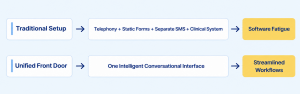
The Solution: Moving from Fragmented Tools to Intelligent Navigation
This is exactly why we built GP Chatbot and our dedicated conversational assistant, AiLeen.
GP Chatbot doesn’t ask your team to learn yet another complex software ecosystem. Instead, it acts as an intelligent, automated digital receptionist that sits at the very front of your practice web and WhatsApp channels.
Here is how a unified conversational front door changes your daily operations:
-
Eliminates Tab Juggling: AiLeen replaces static, disjointed forms and clunky communication silos with a single, intuitive conversational interface for the patient.
-
Automates Data Structuring: Instead of staff manually deciphering unstructured text from an email or a form, GP Chatbot gathers precise demographic, administrative, or triage details dynamically.
-
Streamlines Workflows Directly Into Clinical Systems: The captured data is neatly structured and safely routed exactly where it needs to go, allowing your team to process requests in a fraction of the time.
By shifting your strategy from standalone single-point tools to a unified, automated interface, you instantly unlock hidden administrative capacity. Your staff stop fighting the software and start managing the patient flow. Software should work for your team—your team shouldn’t have to work for the software.