
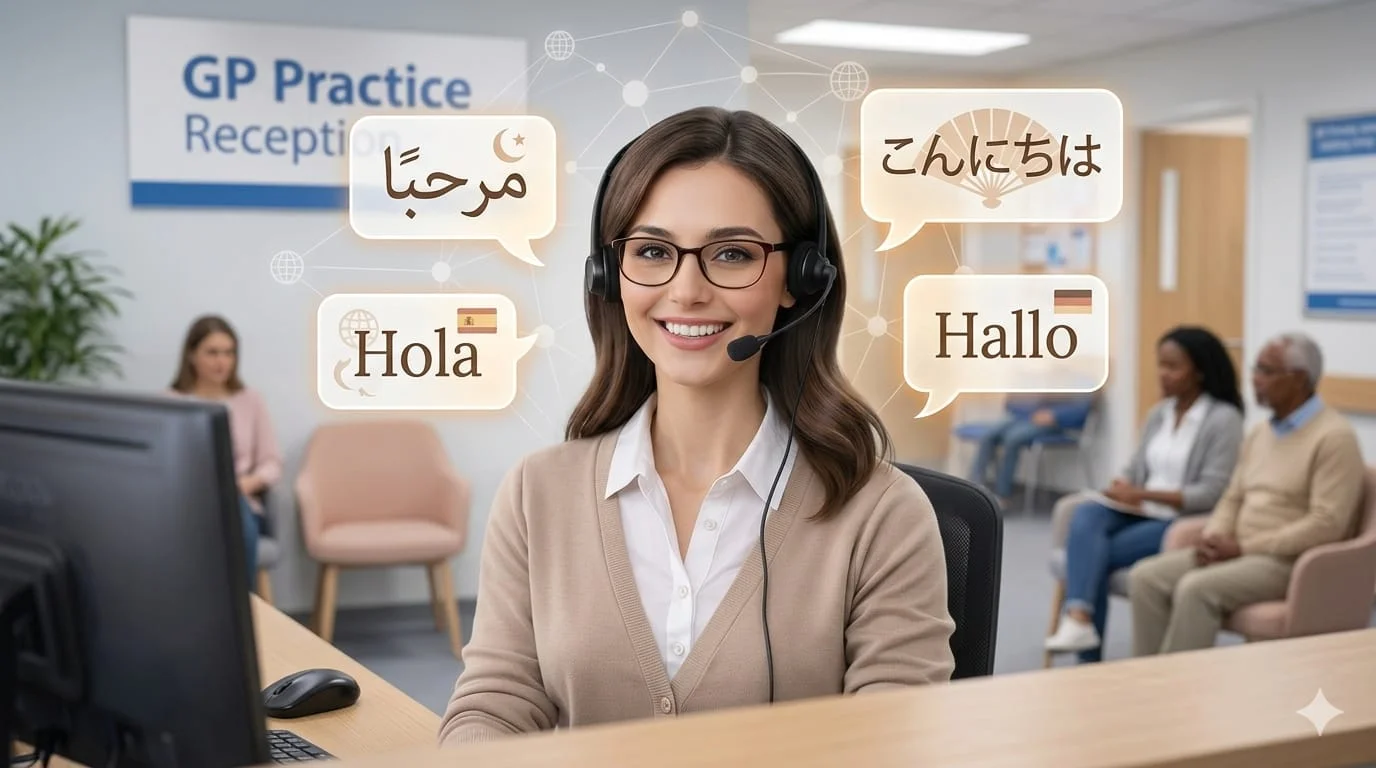
Every patient deserves to feel understood from the moment they reach out to their GP practice. But for millions of people across the UK, that first interaction is already a barrier. Language. When a patient cannot clearly explain their symptoms or does not understand the options being offered to them, the quality of care suffers before it has even begun.
This is where a multilingual chatbot in primary care changes everything. By enabling GP practices to communicate with patients in their preferred language, AI-powered chatbots like Aileen from GPChatBot are removing one of the most persistent and overlooked obstacles in NHS primary care: the language gap.
In this post, we explore why multilingual patient communication matters, how AI chatbots deliver it in practice, and what it means for your practice’s ability to engage every patient effectively.
The Language Barrier in GP Practices: A Hidden Patient Safety Issue
The UK is one of the most linguistically diverse countries in Europe. According to the Office for National Statistics, over 300 languages are spoken across England and Wales. In many urban GP practices, significant portions of registered patients speak English as a second language or not at all.
The consequences of poor language access in healthcare are well-documented. Patients who cannot communicate effectively are more likely to miss appointments, misunderstand treatment plans, and avoid seeking care altogether until conditions become more serious. This creates a cycle that increases pressure on GP surgeries and harms patient outcomes.
Traditional solutions such as telephone interpretation services are slow, costly, and often unavailable during peak hours. A multilingual chatbot in primary care offers something fundamentally different: instant, consistent, and scalable language support that is available around the clock.
How a Multilingual Chatbot Improves Patient Engagement
Patient engagement is about more than getting people through the door. It is about making every individual feel that their practice is accessible, responsive, and designed with them in mind. Multilingual AI chatbots achieve this in several important ways.
1. Immediate Language Recognition
Modern AI chatbots can detect a patient’s preferred language and respond accordingly, without any manual input required from practice staff. A patient who begins interacting with Aileen in Punjabi, Polish, or Portuguese receives a response in that same language. This removes the anxiety many patients feel when contacting their GP, and significantly increases the likelihood that they will complete their query rather than abandon it.
2. 24/7 Accessibility for All Patient Groups
Non-English speaking patients often rely on bilingual family members to make appointments or communicate with their practice during opening hours. This creates dependency, privacy issues, and real difficulty for patients who need to act independently. A chatbot that operates around the clock in multiple languages allows patients to access information, check their options, and take action at any time, in complete privacy.
To learn more about how GPChatBot approaches language access, explore our dedicated page on multilingual support in primary care communication.
3. Consistent Information Delivery
When patients receive information through a consistent, clear channel in their own language, compliance with advice and follow-up actions improves. Whether directing a patient to a local pharmacy, explaining a self-referral pathway, or clarifying how to access test results, a multilingual chatbot delivers the right message every time, with no risk of misinterpretation.
Can AI Chatbots Communicate with Patients in Multiple Languages?
The short answer is yes, and the technology behind it has advanced considerably in recent years. Today’s leading AI chatbots are built on large language models capable of understanding and generating natural, fluent responses in dozens of languages. This is not basic translation. It is a genuine conversational capability that understands context, nuance, and the specific vocabulary of healthcare.
For multilingual support in primary care communication to be truly effective, it must go beyond word-for-word translation. Aileen is built specifically for the NHS primary care environment, which means the language it uses is familiar, appropriate, and clinically safe.
Crucially, this capability does not require practice staff to do anything differently. There are no language settings to manage or separate systems to maintain. The chatbot handles it automatically, flagging queries to the live chat or practice team where a human response is genuinely required.
How Chatbots Help Non-English Speaking Patients
For non-English speaking patients, the barriers to accessing primary care can feel overwhelming. Consider the journey a patient typically faces without language support:
- They call the practice and struggle to communicate with the telephonist
- They are put on hold or asked to call back, increasing frustration
- They either give up entirely or present at A&E for a condition that could have been managed in primary care
- Or they rely on a family member to act as an interpreter, raising serious confidentiality concerns
A multilingual chatbot in primary care eliminates each of these pain points. The patient can interact at any time, on your practice website or through WhatsApp, in their own language, and receive a clear, helpful response immediately.
Practical examples of what Aileen can help non-English speaking patients with include:
- Understanding whether their symptoms need a GP appointment or pharmacy advice
- Navigating self-referral pathways for mental health, physiotherapy, and podiatry
- Requesting sick notes and medical certificates
- Checking on test results and appointment queries
- Finding a local pharmacy or urgent care service
The Practice Manager’s Perspective: Why This Matters Operationally
For practice managers, patient engagement is not just a clinical concern. It has a direct impact on call volumes, staff workload, appointment DNA (did not attend) rates, and the overall reputation of the practice.
When non-English speaking patients cannot access information easily, they tend to call more frequently, take longer on each call, and require more follow-up. This compounds the pressure on reception teams that are already managing hundreds of calls per day.
GPChatBot was built by the founders of Primary Care Management Solutions, a team with over 20 years of hands-on experience in NHS GP surgeries. That background means Aileen is not designed as a generic AI tool. She is built around the real operational demands of a busy practice, including the need to serve linguistically diverse patient populations without placing additional burden on staff.
Practices using Aileen report reduced call volumes, improved patient satisfaction, and staff who are better able to focus on complex cases that genuinely need a human touch. Adding multilingual capability to that equation extends these benefits to every patient in your practice list, regardless of their language.
Multilingual AI and the NHS Equality Duty
GP practices have a legal and ethical obligation to ensure that services are accessible to all patients, including those with limited English proficiency. The NHS Accessible Information Standard and the Equality Act 2010 both require practices to make reasonable adjustments to support patient communication needs.
A multilingual chatbot in primary care is not just a nice feature. For many practices, it is a meaningful step toward meeting these obligations in a scalable, cost-effective way. Rather than relying on expensive interpreter services or placing the burden on bilingual staff, AI makes language access a built-in part of the patient journey.
This is particularly relevant for Primary Care Networks (PCNs) seeking to demonstrate inclusive, population-wide care across diverse communities.
Make Your Practice Accessible to Every Patient
Patient engagement cannot be truly effective if it only works for English-speaking patients. A multilingual chatbot in primary care is one of the most impactful steps a GP practice can take to ensure that every patient, from every background, has genuine access to their healthcare.
Aileen is already doing this for GP practices across the UK. Fully customisable, NHS-aware, and available 24/7 on your website and WhatsApp, she is designed to work the way your practice works and to serve the patients who need it most.
Frequently Asked Questions
How do multilingual chatbots improve patient engagement?
Multilingual chatbots improve patient engagement by removing the language barrier that prevents many patients from accessing GP services confidently. When a patient can interact in their own language, they are more likely to complete their query, follow through on advice, and feel positively about their practice. This reduces missed appointments, lowers unnecessary call volumes, and supports better health outcomes across your patient population.
Can AI chatbots communicate with patients in multiple languages?
Yes. Modern AI chatbots are built on advanced language models capable of understanding and responding in dozens of languages fluently. Aileen can detect the language a patient is using and respond accordingly, with no manual setup required by practice staff. The technology goes well beyond basic translation, offering natural conversational responses that are contextually appropriate for a primary care setting.
How do chatbots help non-English speaking patients?
Chatbots help non-English speaking patients by giving them a private, immediate, and language-appropriate way to access information and support from their GP practice. Instead of struggling to communicate over the phone or waiting for a bilingual family member to be available, patients can use the chatbot at any time to get answers about symptoms, referrals, appointments, and more, all in the language they feel most comfortable in.