
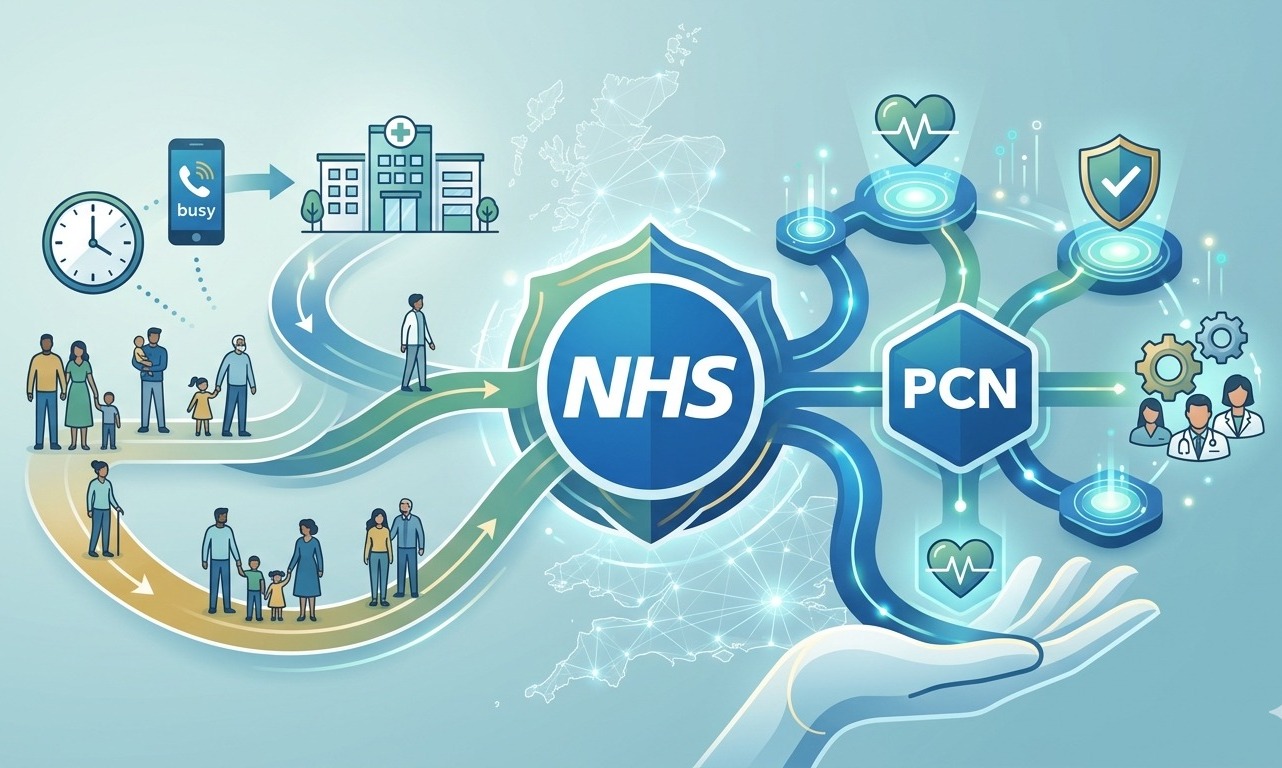
The NHS is one of the most cherished institutions in the United Kingdom and one of the most stretched. Every day, millions of patients attempt to access care across a system that is working harder than ever to meet demand. GP surgeries are often the first port of call, and in many communities, they are already operating beyond comfortable capacity. Understanding how the NHS manages patient access to care, and the role that Primary Care Networks play within that, is increasingly important not just for healthcare professionals, but for anyone who relies on the NHS.
This post explores why the NHS is struggling with patient demand, what PCNs were designed to do about it, and how AI-powered communication tools are helping primary care teams manage the growing pressure more effectively.
Why the NHS Is Struggling With Patient Demand
Patient demand in NHS settings has been rising steadily for years. The reasons are well documented: an ageing population with more complex, long-term health needs; increased public awareness of health conditions; a growing expectation for timely, accessible care; and the lasting impact of the pandemic on both patient backlogs and workforce capacity.
The result is a system under significant strain. Accident and emergency departments see record attendance figures. Hospital waiting lists remain stubbornly long. And at the front line of it all, GP practices absorb an enormous volume of daily contact appointment requests, prescription queries, test result enquiries, referrals, and urgent care signposting, often with staffing levels that have not kept pace with demand.
NHS primary care challenges are not simply about numbers, either. The nature of demand has changed. Patients arrive with more complex presentations. Mental health needs have grown substantially. The boundaries between primary and secondary care continue to shift, with more being managed in the community. All of this places a heavier operational burden on GP practices and the networks that support them.
What Are PCNs and Why Do They Matter?
Primary Care Networks were introduced in 2019 as part of the NHS Long Term Plan. The idea was straightforward: by grouping GP practices together to serve defined local populations, typically between 30,000 and 50,000 patients, PCNs could pool resources, share clinical staff, and deliver services more efficiently than individual practices working in isolation.
Understanding how PCNs help the NHS manage patient demand starts with recognising what they were designed to achieve. Rather than every practice independently managing the full spectrum of primary care needs, PCNs allow for a more coordinated approach. Clinical pharmacists, social prescribing link workers, physiotherapists, and other allied health professionals can be deployed across a network, reaching more patients without every query needing to go through a GP.
This matters enormously for NHS patient flow management. When a patient contacts their GP with a musculoskeletal complaint, a PCN can route them to a first-contact physiotherapist rather than consuming a GP appointment slot. When someone presents with loneliness or social isolation driving their health needs, a social prescribing link worker can intervene. This intelligent distribution of demand across a broader team is one of PCNs’ most significant contributions to the wider system.
How PCN Patient Management Works in Practice
Effective PCN patient management relies on more than just having the right staff — it requires the right systems to direct patients to those staff at the right time. This is where many networks still face real challenges.
How patient demand is managed in primary care comes down to three core functions: identifying what a patient needs, routing them to the most appropriate resource, and following up to ensure continuity. Each of these steps has traditionally been labour-intensive, relying on reception and admin teams to triage calls, pass messages, coordinate between clinicians, and manage the flow of information across multiple sites.
In a PCN spanning several practices, this coordination becomes considerably more complex. Different teams, different systems, different physical locations all of which need to communicate seamlessly to deliver a coherent patient experience. Without effective tools to support this, even the best-designed PCN structure can become bogged down in operational friction.
The Role of AI in Managing Patient Demand
This is where technology — and specifically AI-powered communication tools — is beginning to make a meaningful difference. How AI helps manage patient demand in healthcare is no longer a theoretical question. Practices and PCNs already using AI tools are seeing tangible results: fewer calls to reception, faster patient responses, better use of clinical time, and measurable improvements in patient satisfaction.
AI chatbots, in particular, are proving their value as a front-door solution for primary care. When a patient contacts a GP practice website or messaging platform, an AI chatbot can immediately handle a wide range of routine queries without any member of staff needing to be involved. Appointment information, sick note processes, self-referral pathways, pharmacy signposting, and test result guidance can all be managed automatically, at any time of day or night.
For access to care NHS-wide, this matters because it extends the availability of information beyond office hours. The 8am rush when hundreds of patients simultaneously attempt to contact their practice for appointments is one of the most recognised pressure points in primary care. AI tools that allow patients to interact with the practice outside peak hours, or to resolve their query without calling at all, directly reduce that bottleneck.
Beyond the chatbot interaction itself, AI also enables smarter routing. Rather than a patient waiting in a phone queue only to be told they need to speak to someone else, an intelligent system can assess the nature of the query and direct the patient to the right pathway immediately, whether that is a GP appointment, a PCN service, an urgent care referral, or a community resource.
AiLeen: Built for Primary Care, Designed for PCNs
GPChatBot’s AI assistant AiLeen was developed by people who have worked in NHS primary care for over two decades. That background matters because primary care is not a generic environment. The pressures, the workflows, the regulatory requirements, and the patient populations are all specific, and a tool built without that understanding will fall short.
AiLeen handles the kinds of queries that consume reception time across every practice: appointment queries, prescription requests, symptom signposting, service directions, and administrative information. She is available on both the practice website and via WhatsApp, meeting patients through the channels they already use. And she is fully customisable for each PCN, so local pathways and services can be built in from the start, ensuring patients are directed to the right resource within the network, not just a generic NHS page.
For PCNs working to improve NHS patient flow management, AiLeen functions as an intelligent first point of contact that triages patient demand before it ever reaches a human team member. The result is a reception team that is less overwhelmed, a clinical team that is better protected, and patients who get faster, clearer answers.
The Wider Benefits for the NHS
When PCNs operate effectively, supported by the right digital infrastructure, the benefits ripple outward through the NHS system. Fewer unnecessary GP appointments mean more capacity for complex cases. Better signposting reduces inappropriate A&E attendances. Earlier intervention through community services prevents conditions from escalating to secondary care.
Access to care NHS-wide improves when primary care is functioning well. PCNs, at their best, are a critical part of making that happen. And as patient demand in NHS settings continues to grow, the tools that support PCN patient management will become increasingly important, not optional extras, but core infrastructure for a sustainable primary care system.
Frequently Asked Questions
How do PCNs help the NHS manage patient demand?
By pooling staff and resources across multiple practices, PCNs route patients to the right professional, reducing unnecessary GP appointments and managing demand more efficiently across the network.
Why is the NHS struggling with patient demand?
An ageing population, growing complexity of health needs, pandemic backlogs, and rising patient expectations have all contributed to demand outpacing available capacity.
How does AI help manage patient demand in healthcare?
AI handles routine queries automatically, routes patients to the right service, and extends practice availability beyond office hours, reducing pressure on reception and clinical teams.
What is NHS patient flow management?
It is the process of directing patients to the most appropriate care pathway at the right time, avoiding bottlenecks and ensuring resources are used where they are most needed.
Can AI tools work across a whole PCN, not just one practice?
Yes. Tools like AiLeen can be configured to reflect the full range of services and pathways across a network, ensuring consistent patient communication at the PCN level.
Conclusion
The question of how PCNs help the NHS manage patient demand is ultimately a question about system design. PCNs exist because no single GP practice can absorb the full weight of community health needs alone. But PCNs can only deliver on their potential when they are supported by tools that match the scale and complexity of the task.
AI-powered communication tools are becoming a central part of that support. By automating first-contact interactions, intelligently routing patient demand, and extending access to care beyond traditional working hours, they help PCNs tackle NHS primary care challenges more effectively and ensure that every patient reaches the right care, at the right time.