
Every call has a cost. But has your practice ever calculated what that cost looks like at scale?
A two-minute telephone enquiry may not seem significant.
A patient wants to know how to request a repeat prescription. Someone is checking how to access test results. Another patient needs practice information or wants to know which service they should contact.
Individually, these are small interactions.
Across hundreds of calls every week, however, they represent something much more valuable:
Staff capacity.
For Practice Managers, GP Partners and primary care leaders, understanding the cost of telephone demand isn’t simply about reducing calls. It is about understanding where staff time is being used, where routine demand could be handled differently, and what operational value could potentially be released.
That is where the conversation around digital patient access and ROI in general practice becomes much more interesting.
How Much Telephone Demand Is General Practice Managing?
Telephone access remains a major part of how patients contact general practice.
NHS England reported 29.2 million calls to GP practices in February 2026 alone, more than one million calls every working day. At the same time, practices received a record 8.6 million online consultation submissions during February, with 83 million submitted over the preceding 12 months. NHS England
Those numbers reveal something important.
The future of patient access isn’t necessarily telephone versus digital.
Practices increasingly need to manage several access routes at once while making sure patients can reach the right support through the right channel.
NHS England’s modern general practice model reflects this approach. It encourages practices to optimise telephone, online and in-person contact channels, understand patient need at the point of contact, and align available capacity with demand. NHS England
For practice leaders, therefore, the question becomes:
How much of our telephone demand genuinely requires staff intervention, and how much routine demand could potentially be supported digitally?
What Is the Hidden Cost of Routine Calls in a GP Practice?
The cost of a patient call isn’t limited to the telephone system.
There is also the staff time required to handle it.
Consider the routine enquiries a reception or administrative team may encounter throughout a normal working day:
- appointment queries
- prescription requests
- test-result enquiries
- opening times and practice information
- service-navigation questions
- administrative requests
- questions about where to access appropriate support
A single interaction may only require a few minutes.
But the calculation changes when you consider:
Calls per day × average call duration × working days × staff cost
Suddenly, a series of small interactions becomes a measurable use of administrative capacity.
That doesn’t mean those conversations are unnecessary.
Some patients need telephone access. Some enquiries require human judgement or reassurance. Some situations are too complex for a digital route.
The opportunity is to identify appropriate routine demand that doesn’t always need to begin with a member of the practice team answering a telephone call.
Can Digital Patient Access Reduce Telephone Demand?
It can help shift some patient contacts away from the telephone when digital journeys are designed appropriately.
NHS England’s guidance on improving online journeys specifically identifies relieving telephone-volume pressure and the 8am phone rush among the potential benefits of moving suitable contacts online. It also emphasises maintaining different access routes rather than treating digital access as a replacement for telephone or in-person contact. NHS England
This distinction matters.
Digital patient access should not mean removing human access.
Instead, the goal should be to make routine information and appropriate pathways easier to access digitally while preserving staff capacity for patients and situations where human support adds greater value.
NHS England has similarly identified reduced administrative workload and increased operational efficiency among the potential benefits of GP online services, with released time available for other aspects of care and patient support. NHS England
That takes us from simply discussing call volumes to discussing capacity.
Staff Capacity Is Part of the ROI Conversation
When people hear return on investment, the conversation often moves immediately towards financial savings.
But ROI in general practice can be broader than direct cash savings.
Suppose a digital solution reduces the amount of staff time required for appropriate routine enquiries.
The value isn’t necessarily:
We can remove £X from our staffing budget.
A more useful question may be:
What could our team do with the capacity released?
That capacity could potentially be redirected towards more complex patient enquiries, supporting patients who need human assistance, practice administration, care navigation or service improvement.
For a Practice Manager evaluating digital technology, this means a business case can consider several dimensions:
Financial value What is the estimated value of staff time involved?
Staff capacity How much administrative time could potentially be released?
Operational efficiency Could routine demand be handled differently?
Patient access Can patients find appropriate information and routes more easily?
Patient experience Does the approach preserve choice for people who need telephone or in-person support?
That is a more meaningful way to think about the ROI of digital patient access in general practice.
How Can a GP Practice Calculate the Cost of Telephone Demand?
There isn’t one universal figure because every practice operates differently.
Consider two practices with the same registered list size.
One may receive substantially more telephone calls. One may have longer average call durations. Their staffing costs may differ. Their patients may use digital access differently.
Any useful ROI estimate therefore needs to begin with practice-specific assumptions.
For example, imagine a practice with:
| Variable | Example |
|---|---|
| Registered list size | 8,000 |
| Calls received per working day | 150 |
| Average call length | 2.5 minutes |
| Telephone demand potentially shifted digitally | 55% |
| Loaded admin cost | £20/hour |
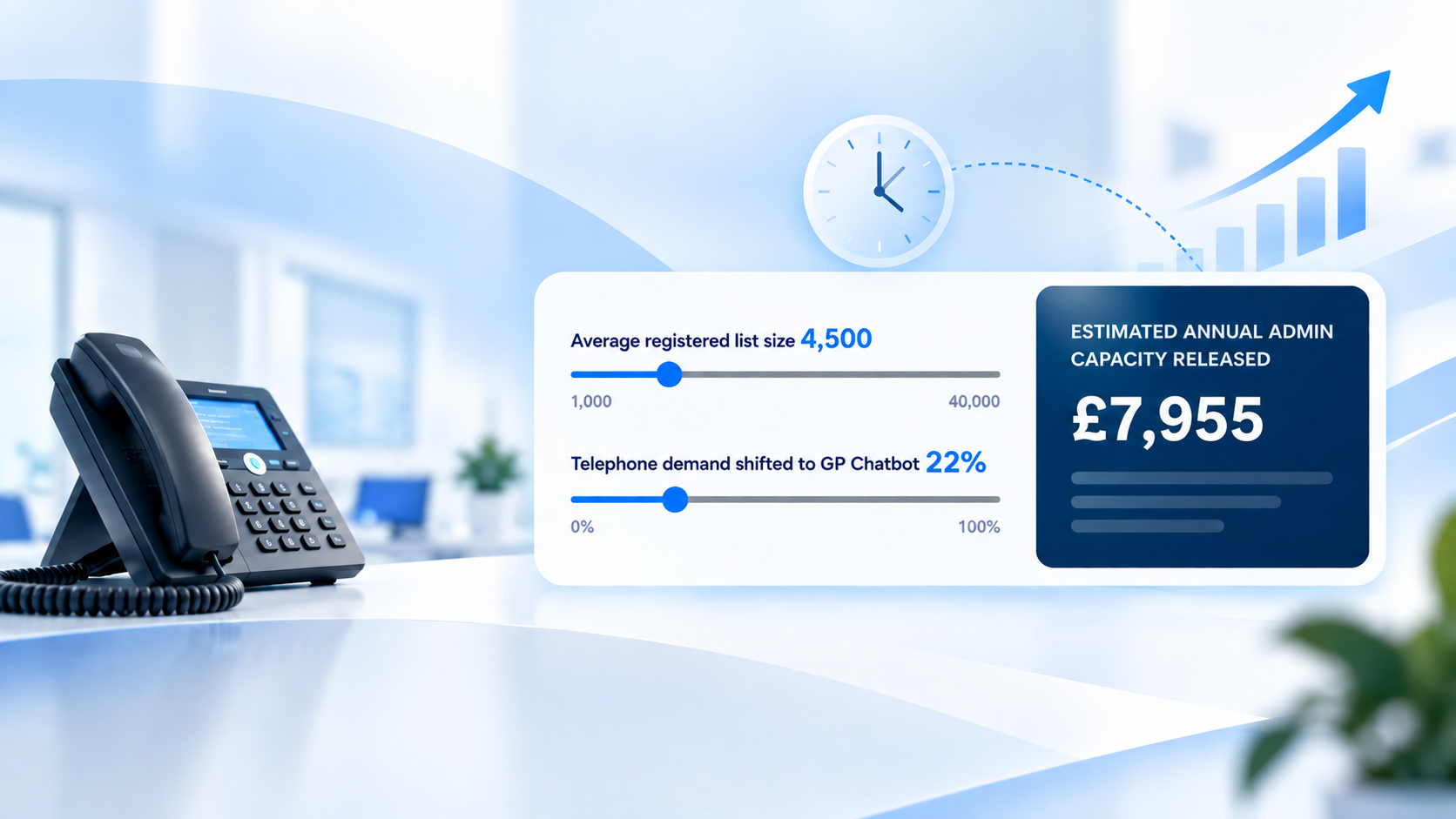
Using these assumptions in the GP Chatbot Practice ROI Calculator produces an estimated:
£17,394 in annual admin capacity released
That figure needs an important qualification.
It is not a guaranteed £17,394 cash saving.
It is an estimate of the value of staff time that could potentially be redirected from routine telephone demand towards higher-value patient support, based on the assumptions entered into the calculator.
Change the inputs and the result changes.
And that’s precisely the point.
Introducing the GP Chatbot Practice ROI Calculator
Rather than applying one generic savings claim to every organisation, the Practice ROI Calculator allows practices to explore the potential opportunity using their own operational assumptions.
You can adjust variables including:
- average registered list size
- calls received per working day
- average call length
- proportion of telephone demand potentially shifted to GP Chatbot
- loaded administrative cost per hour
The calculator then estimates the annual admin capacity that could potentially be released.
Try the GP Chatbot Practice ROI Calculator
The purpose isn’t to provide a guaranteed financial outcome.
It is to give Practice Managers, GP Partners and PCN leaders a more useful starting point for evaluating the potential business case for digital patient access.
Where Could AI Fit Into Digital Patient Access?
AI introduces another possibility within this wider shift towards digital access.
For appropriate routine enquiries, conversational technology can make information and navigation available without requiring every interaction to begin with a telephone call.
GP Chatbot’s AiLeen is designed around this role: supporting routine enquiries and patient navigation digitally while allowing practice teams to remain focused on interactions where their experience and human input matter most.
This shouldn’t be viewed as AI replacing reception teams.
A more useful way to frame the question is:
Which interactions require people, and which routine interactions could technology support effectively?
That distinction is particularly important in healthcare, where efficiency needs to sit alongside accessibility, patient choice, safety and appropriate human involvement.
Does Digital Access Mean Patients Should Stop Calling?
No.
Effective digital access isn’t about forcing every patient into one channel.
NHS England’s modern general practice model explicitly describes telephone, online and in-person access as part of the overall access model and emphasises a smooth and equitable patient experience across those routes. NHS England
Some patients will prefer telephone access.
Others may need it because of accessibility, language, digital confidence or the complexity of their enquiry.
But when patients who can and want to self-serve routine information digitally have an effective way to do so, telephone capacity can potentially be preserved for those who need it.
That’s a very different proposition from simply trying to reduce call numbers.
From Telephone Demand to a Practice Business Case
The conversation around digital technology often starts with:
“How much does it cost?”
That’s an important question.
But it shouldn’t necessarily be the first one.
Before assessing the cost of introducing a new solution, practices can also ask:
How much routine telephone demand are we currently handling?
How much staff time does that represent?
Which enquiries could appropriately be handled digitally?
What could released administrative capacity be worth?
Where could that capacity create greater value?
Those questions turn the discussion from technology procurement into a broader conversation about demand, capacity and operational value.
And importantly, the answers will be different for every practice.
Your Practice. Your Numbers. Your Business Case.
General practice isn’t moving from telephone access to digital access.
It is increasingly operating in a multi-channel environment, where telephone, online and in-person routes need to work together.
NHS England’s current approach similarly focuses on understanding demand, improving patient journeys and aligning capacity with need. NHS England
For practices considering AI and other digital tools, that creates a straightforward principle:
Don’t start with a generic promise. Start with your numbers.
Understand your telephone demand.
Understand the staff capacity behind it.
Explore which routine interactions could appropriately be supported digitally.
Then calculate what that could potentially mean for your organisation.
Every call has a cost. The useful question is what that cost looks like for your practice.