
Artificial intelligence (AI) is becoming an increasingly important part of the conversation around the future of general practice.
But as more GP surgeries explore AI-powered tools, one question deserves particular attention:
Is AI in general practice simply about reducing costs, or can it create meaningful value for patients and healthcare teams?
For practice managers and GP partners, financial efficiency will always be a consideration. With growing demand, stretched resources and rising operational pressures, every investment needs a clear purpose.
However, the potential value of AI goes beyond the numbers on a balance sheet.
When implemented responsibly, AI can help reduce GP reception workload, manage routine administrative enquiries and create opportunities for staff to spend more time supporting patients.
The question is not simply how much money technology could save, but what practices can achieve with the capacity it helps release.
The Growing Administrative Pressure on GP Reception Teams
GP reception teams play a vital role in how patients access primary care.
From handling appointment enquiries and prescription requests to explaining practice procedures and signposting patients towards appropriate services, their responsibilities extend far beyond answering telephone calls.
Many of these enquiries are routine, but they still require staff time and attention.
During busy periods, particularly the familiar morning telephone rush, repetitive enquiries can contribute to longer waiting times and increased pressure on reception teams.
According to NHS England’s national context for digital primary care, research indicates that approximately 44% of administrative and clerical tasks in general practice could be mostly or completely automated.
This does not mean that 44% of reception work can simply be removed, or that receptionists can be replaced. It highlights the opportunity to redesign certain processes so that staff can focus on tasks where human judgement, empathy and experience are essential.
For practice managers, this is an important distinction.
The objective should be to reduce unnecessary administrative pressure, not remove the human element from patient care.
How Can AI Reduce GP Reception Workload?
AI-powered reception assistants can support practices by providing patients with another convenient route to routine information and services.
Rather than requiring every enquiry to begin with a telephone call, suitable requests can be addressed through digital channels.
1. Managing Routine Patient Enquiries
A significant part of reception activity involves answering recurring questions.
Patients may want to know:
- How to request a repeat prescription.
- Where to find opening hours or contact information.
- How to access test results.
- How to obtain a fit note.
- Which practice services are available and how to access them.
An appropriately configured AI receptionist can provide information about established practice procedures and guide patients towards relevant services.
This can reduce the need for some routine telephone conversations while allowing reception staff to focus on enquiries requiring personal assistance.
2. Supporting Digital Patient Access
Not every patient needs to speak to a receptionist to obtain basic information.
Providing a simple digital route can help patients find answers at a time that suits them, including outside normal practice opening hours.
NHS England’s modern general practice model emphasises accessible contact channels, structured information gathering and effective care navigation.
AI reception tools can support parts of this approach by helping patients understand available options and find appropriate routes to assistance.
Importantly, digital access should complement telephone and in-person services rather than create barriers for patients who cannot or prefer not to use technology.
3. Helping Patients Navigate Practice Services
Some patients contact their GP surgery because they are unsure which service or process is appropriate.
For example, a patient might need information about local pharmacy services, self-referral options or how to submit a routine administrative request.
An AI receptionist can help explain relevant pathways based on approved practice information.
However, patient safety and context must remain central.
AI should not be treated as a substitute for clinical judgement. Unclear, sensitive or potentially urgent enquiries require appropriate safeguards, escalation instructions and access to human or clinical support.
The aim is not simply to provide a quick answer, but to help patients find the right next step.
Beyond Cost Savings: The Wider Value of AI in General Practice
Financial return is important, particularly when practices are operating within limited budgets.
But evaluating AI solely through potential cost reductions misses several operational considerations.
More Capacity for Meaningful Patient Support
When routine administrative enquiries can be handled through appropriate digital processes, reception teams may have additional capacity to assist patients with more complex needs.
This could mean spending more time supporting someone who struggles with online services, needs reassurance or requires help navigating an unfamiliar process.
It is an opportunity to use staff capacity more effectively, rather than automatically equating efficiency with fewer staff.
A More Flexible Patient Experience
Patients have different communication preferences and accessibility needs.
Some prefer speaking directly to reception. Others may find it easier to obtain routine information online or through familiar messaging services.
Offering multiple access routes can create a more flexible experience, provided those routes remain clear, inclusive and connected to safe practice processes.
Better Visibility of Patient Demand
Digital interactions can also provide useful operational information.
Practices can review the types of enquiries being received, identify frequently requested information and assess how digital engagement changes over time.
This information may help practice managers make more informed decisions about patient communications, reception workflows and service improvements.
However, chatbot activity alone does not prove that telephone demand has fallen or that patient outcomes have improved. These benefits need to be evaluated using appropriate practice-level evidence.
What Should GP Practices Measure When Evaluating AI?
Introducing an AI receptionist is only the beginning.
To understand whether it delivers meaningful value, practice managers should monitor indicators that connect technology usage with operational performance.
Key measurements include:
- Chatbot engagement: How frequently patients use the digital service.
- New and returning users: Whether patients are discovering and continuing to use the service.
- Routine enquiries managed: Which requests can be addressed appropriately through digital pathways.
- Estimated administrative capacity: How much staff time could potentially be released.
- Patient experience: Whether patients find the service clear, accessible and useful.
- Safety and escalation: Whether complex, ambiguous or urgent requests are handled appropriately.
These measures help practices look beyond simple activity totals.
For example, growing chatbot usage may suggest increasing awareness and adoption. But confirming a reduction in reception workload requires additional evidence, such as changes in routine call volumes and handling time.
Successful AI adoption should be measured through meaningful improvements, not technology usage alone.
Understanding the ROI of an AI Receptionist
Return on investment (ROI) remains an important part of assessing any new technology.
However, there is a difference between potential financial value and realised cash savings.
If a digital assistant helps patients resolve suitable enquiries without making a telephone call, the resulting reduction in staff handling time could create additional administrative capacity.
That capacity might be redirected towards patient support, other reception responsibilities or improvements in practice workflows.
It does not automatically mean that staffing expenditure will fall.
A useful ROI assessment should consider:
- The practice’s daily telephone call volume.
- The average length of routine calls.
- The proportion of demand that could appropriately move to a digital channel.
- The cost of staff time.
- The ongoing cost of the digital solution.
Using realistic assumptions allows practices to explore the potential operational value before making an investment.
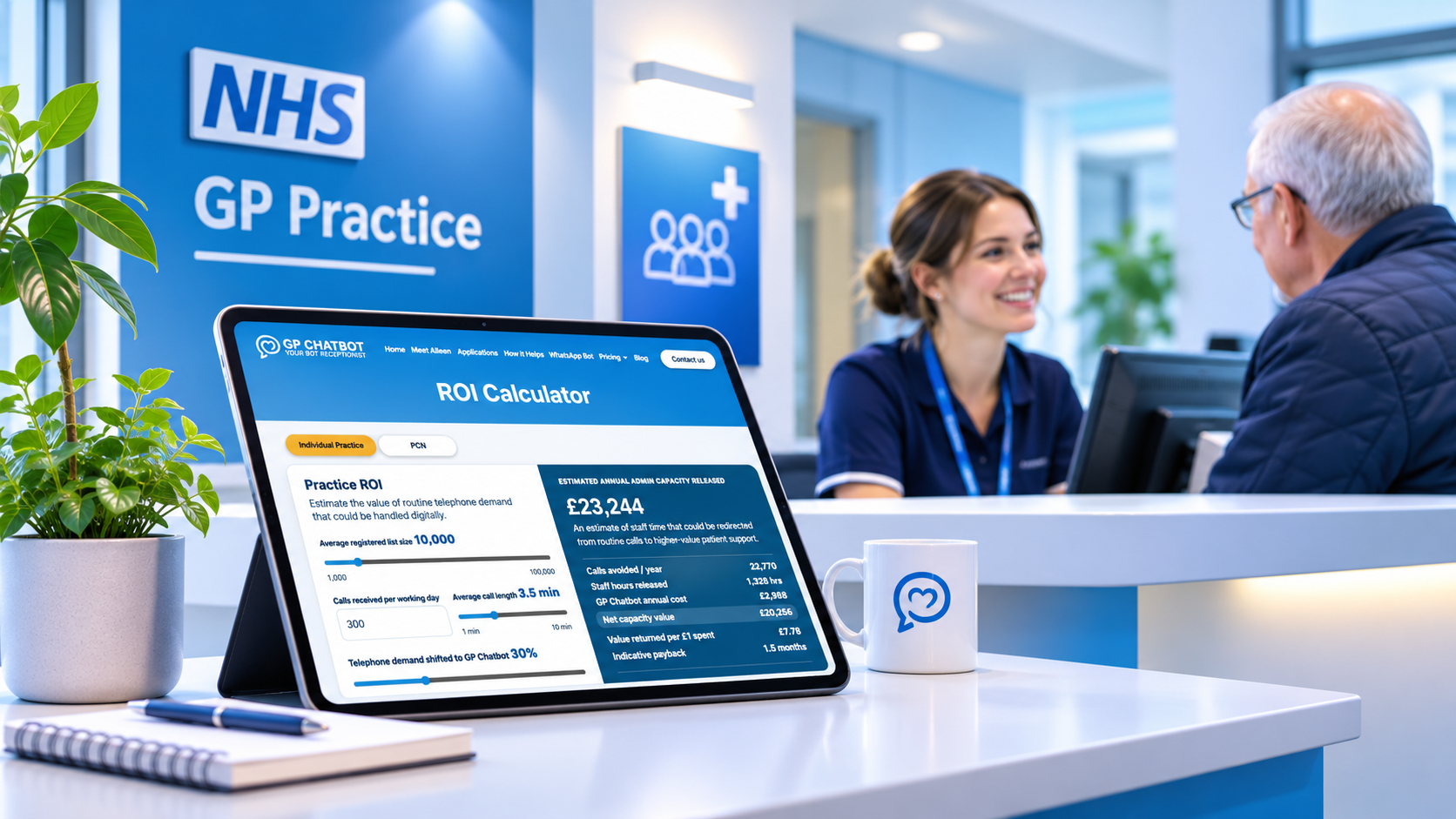
Explore the GP Chatbot Practice ROI Calculator
To help practices assess these questions, GP Chatbot provides a Practice ROI Calculator.
The calculator allows practice managers and PCN decision-makers to explore their own call volumes, handling times, staffing costs and potential digital uptake.
It estimates the annual administrative capacity that could be released, alongside the illustrative financial value of that time.
The results are estimates rather than guaranteed savings, but they provide a starting point for understanding where improved efficiency could create value.
Where GP Chatbot Fits into the Picture
At GP Chatbot, we believe the purpose of AI should be to support both patients and practice teams.
AiLeen, our 24/7 AI receptionist, is designed to help GP practices manage suitable routine enquiries, provide relevant practice information and guide patients towards available services.
Available through practice websites and WhatsApp, AiLeen offers patients additional ways to access information without relying exclusively on telephone contact.
For practices, this can support a more flexible digital front door and help manage repetitive administrative demand.
Our approach also recognises the importance of testing, clarity, appropriate signposting and maintaining access to human support.
Technology should complement the experience of reception teams, not attempt to replace the judgement and compassion they provide.
The Future of AI in General Practice Is About Creating Value
The conversation around AI in primary care should not be limited to whether it reduces expenditure.
For GP practices, the opportunity is broader: reducing repetitive administrative pressure, helping patients navigate services and enabling reception teams to use their time where it matters most.
Financial efficiency remains part of that picture, but it should be considered alongside accessibility, patient experience, safety and operational capacity.
Ultimately, the real value of an AI receptionist is not simply how quickly it can answer a question.
It is how effectively it supports patients, strengthens practice workflows and helps human teams focus on the people who need them.
Ready to Explore What AI Could Mean for Your Practice?
Discover the potential operational value of managing routine telephone demand digitally.
Explore the GP Chatbot ROI Calculator
Or visit www.gpchatbot.com to learn more about AiLeen and arrange a demonstration.