
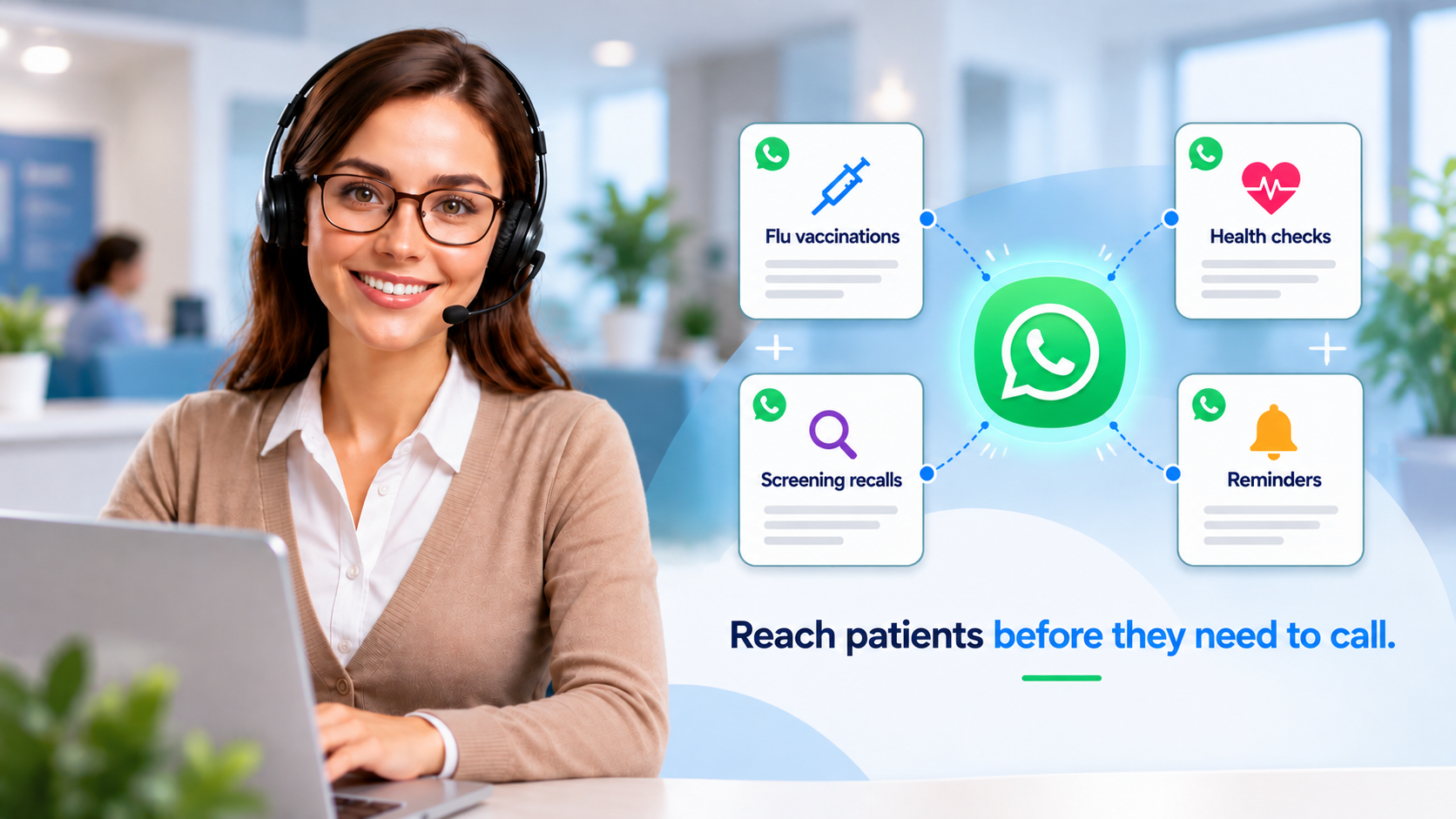
What if one message today could prevent hundreds of routine patient enquiries tomorrow?
For GP practices across the UK, keeping patients informed is an ongoing challenge. From seasonal flu vaccinations and screening recalls to long-term condition (LTC) reviews and important service announcements, effective patient communication requires time, planning and coordination.
Traditionally, practices have relied on telephone calls, letters and text messages to communicate with patients. While these methods remain important, relying heavily on individual follow-ups can place additional pressure on already busy reception and administrative teams.
But patient communication doesn’t always have to begin with an incoming call.
With GP Chatbot WhatsApp Broadcast and Recall Campaigns, practices can proactively share approved reminders, invitations and important updates with relevant patient groups.
Instead of waiting for patients to ask, practices can reach out with timely information and clear next steps.
Don’t just respond to demand. Reach patients proactively.
Why Proactive Patient Communication Matters
Every day, GP reception teams handle questions about appointments, vaccinations, screenings, health checks and routine practice services.
Some enquiries require individual assistance. Others involve information that could be communicated in advance.
Patients may contact their practice to ask:
- When are flu vaccination appointments available?
- Am I due for a routine screening?
- How do I arrange my long-term condition review?
- Are there any upcoming health and wellbeing programmes?
- How can I book an appointment for a service I’ve been invited to attend?
Individually, these questions may seem straightforward. Collectively, they can create a considerable administrative workload.
Proactive patient communication helps practices address some of these questions before patients need to call.
By sharing relevant information with appropriate patient groups, practices can help people understand which services are available, when action may be needed and how to take the next step.
For practice managers and primary care networks (PCNs), this offers a more organised approach to routine patient outreach.
What Are WhatsApp Broadcast and Recall Campaigns?
WhatsApp Broadcast and Recall Campaigns allow GP practices to send approved communications to selected groups of patients through WhatsApp.
Rather than relying solely on individual telephone calls, letters or manual follow-ups, practices can use targeted messaging to support routine outreach and recall activities.
With GP Chatbot WhatsApp Campaigns, practices can communicate about:
- Flu vaccination invitations
- Screening recalls and reminders
- Long-term condition (LTC) reviews
- NHS health checks
- Health and wellbeing initiatives
- Relevant NHS programmes
- Practice announcements and service updates
- Approved appointment and booking pathways
The aim is not simply to send more messages.
It’s to ensure that the right information reaches the right patients at the right time, helping them understand what action to take.
Three Ways GP Chatbot WhatsApp Campaigns Support Patient Communication
GP Chatbot’s WhatsApp Campaigns capability supports three important areas of proactive communication.
1. Targeted Reminders: Encourage Patients to Book or Respond
GP practices regularly need to invite eligible patients to attend appointments, reviews and preventive healthcare services.
These activities can require considerable administrative coordination, particularly when reaching larger patient groups.
WhatsApp campaigns can support targeted reminders for activities such as:
Flu vaccination invitations
Practices can inform eligible patients when seasonal vaccination appointments are available and provide approved booking instructions.
Screening recalls
Relevant patients can receive appropriate reminders about screening programmes and the next steps available to them.
Long-term condition reviews
Practices can invite patients to arrange routine reviews for ongoing conditions, using carefully worded messages that protect patient confidentiality.
NHS health checks
Eligible patients can receive invitations and information about arranging preventive health assessments.
By providing timely reminders and clear instructions, practices can encourage patients to respond without depending entirely on individual outbound calls.
2. Awareness and Outreach: Keep Patients Informed
Not every patient communication needs to be an appointment reminder.
GP practices also play an important role in raising awareness of preventive healthcare, wellbeing services and NHS initiatives.
WhatsApp campaigns can help practices promote relevant programmes to appropriate patient groups.
For example, practices may wish to communicate about:
- Seasonal health awareness initiatives
- Preventive healthcare opportunities
- NHS screening programmes
- Health and wellbeing services
- Changes to available practice services
- Important public health information
A proactive awareness campaign can help patients understand what support is available and where to find further information.
For reception teams, sharing consistent information in advance may also reduce repeated questions about the same programme or announcement.
3. Campaign Follow-Up: Make the Next Step Clear
Sending an invitation is only one part of effective patient communication.
Patients also need to understand what to do after receiving a message.
GP Chatbot WhatsApp Campaigns can support approved follow-up communications by sharing relevant appointment information or booking pathways.
For example, after a vaccination invitation, a follow-up message could remind eligible patients how to arrange their appointment.
A screening awareness campaign could direct recipients to an approved information or booking route.
Clear follow-up instructions help make communications more actionable and reduce uncertainty about the next step.
Effective outreach isn’t just about reaching patients. It’s about helping them respond.
From Reactive Enquiries to Proactive Patient Engagement
Consider a GP practice preparing for its annual flu vaccination programme.
Without proactive outreach, patients may begin calling reception to ask whether appointments are available, when clinics start and how to book.
Each enquiry requires time and attention from the practice team.
Now consider a different approach.
Before the programme begins, the practice sends an approved WhatsApp campaign to eligible patients, explaining vaccination availability and the appropriate booking pathway.
Patients receive the information directly and can follow the instructions without necessarily contacting reception for basic details.
The practice can also send an appropriate follow-up reminder to the relevant patient group.
This is the potential value of proactive patient communication.
One well-timed campaign can answer common questions before they become incoming enquiries.
Although the impact on call volumes will depend on patient engagement and campaign effectiveness, targeted WhatsApp messaging offers a practical way to support routine outreach.
How WhatsApp Campaigns Can Support Busy GP Reception Teams
Reception teams are essential to the smooth running of GP practices.
They help patients navigate services, manage enquiries and coordinate administrative processes.
However, repetitive questions and individual follow-up activities can take time away from tasks requiring personal attention.
By sharing approved information proactively, WhatsApp campaigns may help practices:
- Reduce repetitive telephone enquiries about routine services.
- Limit reliance on individual outbound reminder calls.
- Support vaccination and screening recall activity.
- Share consistent information with relevant patient groups.
- Communicate important practice updates more efficiently.
- Provide clear booking instructions and follow-up pathways.
- Allow reception teams to focus on enquiries requiring individual assistance.
WhatsApp Campaigns are not designed to replace reception staff or traditional patient access channels.
Instead, they offer an additional communication tool to help practices manage routine outreach more effectively.
Why WhatsApp Is a Useful Channel for GP Patient Communication
Introducing new digital services can be challenging when patients are unfamiliar with the technology.
WhatsApp offers a familiar communication environment for many people.
Patients who already use WhatsApp in everyday life may find it convenient to receive appropriate practice reminders and updates through the same application.
Familiar Communication
Patients who already use WhatsApp can receive messages through an interface they recognise.
Timely Patient Updates
Practices can communicate important information when it becomes relevant rather than waiting for patients to make enquiries.
Targeted Outreach
Campaigns can be directed towards appropriate patient groups, helping practices share information with people for whom it is relevant.
Consistent Messaging
Approved campaign messages help practices communicate clear and consistent information.
Clear Next Steps
Messages can include appropriate instructions, helping patients understand how to book, respond or access further information.
WhatsApp should complement existing patient communication methods, ensuring that people who do not use the platform can still access information through suitable alternatives.
How GP Chatbot WhatsApp Broadcast and Recall Campaigns Work
GP Chatbot helps primary care organisations improve digital patient communication and manage routine administrative demand.
Its WhatsApp Broadcast and Recall Campaigns capability supports practice-approved outreach to relevant patient groups.
A typical campaign can be organised into five stages.
Step 1: Identify the Campaign Objective
Determine what the practice needs to communicate.
This could be a flu vaccination invitation, screening recall, LTC review reminder or important practice announcement.
Step 2: Prepare an Approved Message
Create a clear, concise message explaining the purpose of the communication and any action the patient should take.
The content should be appropriate for the intended audience and avoid unnecessary sensitive information.
Step 3: Identify the Relevant Patient Group
Use an appropriate, approved patient list and ensure the necessary lawful basis, consent or communication preferences and confidentiality safeguards are in place.
Step 4: Send the WhatsApp Campaign
Following the required Meta message-template approval and relevant practice approvals, the campaign can be distributed through the WhatsApp messaging service.
Step 5: Support Follow-Up Communication
Where appropriate, practices can share approved reminders, appointment information or booking pathways to help patients understand their next steps.
This approach allows practices to organise communication around patient needs rather than relying exclusively on incoming enquiries.
WhatsApp Campaigns and AiLeen: Proactive and Responsive Patient Communication
GP Chatbot supports two complementary approaches to patient communication.
WhatsApp Broadcast and Recall Campaigns help practices initiate communication by sharing approved reminders, invitations and important updates.
AiLeen, GP Chatbot’s 24/7 digital assistant, supports patients who initiate routine enquiries by providing information and appropriate signposting through supported digital channels.
These capabilities serve different but related purposes.
For example, a WhatsApp campaign might inform eligible patients that flu vaccination appointments are available.
Separately, AiLeen can help patients navigate supported routine practice information when they need assistance.
Together, these capabilities can support a more connected communication experience.
WhatsApp Campaigns help practices reach out. AiLeen helps patients find information when they reach in.
Responsible and Appropriate Patient Messaging
Effective healthcare communication must also respect patient privacy and communication preferences.
GP practices using WhatsApp campaigns should ensure that outreach is practice-approved and supported by an appropriate lawful basis, approved patient lists, relevant consent or communication preferences and the required Meta template approvals.
Messages should avoid unnecessary disclosure of confidential patient information and follow applicable UK GDPR requirements and relevant NHS guidance.
These safeguards help practices use proactive messaging appropriately while maintaining patient trust.
Better Patient Communication Starts Before the First Call
For GP practices, improving patient communication doesn’t always mean adding more work for reception teams.
Sometimes, it begins with sharing the right information before patients need to ask for it.
A timely flu vaccination invitation, screening recall or long-term condition review reminder can help patients understand what action they need to take.
An awareness campaign can make relevant NHS programmes and practice services more visible.
A clear follow-up message can help patients navigate the next step.
With GP Chatbot WhatsApp Broadcast and Recall Campaigns, practices can take a more proactive approach to patient outreach while supporting routine administrative workflows.
Why wait for patients to call when you can reach them first?
Make Patient Communication More Proactive with GP Chatbot
Whether you’re planning flu vaccination invitations, screening recalls, long-term condition reviews or important practice announcements, GP Chatbot WhatsApp Campaigns can help you communicate with relevant patient groups.
Discover how proactive WhatsApp outreach and AiLeen’s digital assistance can support a more organised patient communication experience.
Book a personalised GP Chatbot demo to explore WhatsApp Broadcast and Recall Campaigns for your practice.
Visit www.gpchatbot.com
Frequently Asked Questions
What are WhatsApp Broadcast and Recall Campaigns for GP practices?
WhatsApp Broadcast and Recall Campaigns allow GP practices to send approved reminders, invitations and important updates to selected patient groups through WhatsApp, subject to the required communication permissions and safeguards.
How can GP practices use WhatsApp for patient recalls?
Practices can use appropriate WhatsApp campaigns to invite eligible patients for routine activities such as screening appointments, vaccination programmes and long-term condition reviews.
Can WhatsApp Campaigns help reduce calls to GP reception?
Proactive messages may reduce repetitive enquiries by providing patients with relevant information before they need to contact reception. Actual results depend on the campaign, patient engagement and existing practice workflows.
Can WhatsApp Campaigns support NHS health programmes?
Yes. Practices can use appropriate campaigns to communicate about relevant NHS programmes, preventive healthcare initiatives and health awareness activities.
Can practices send follow-up reminders through WhatsApp?
GP Chatbot’s campaign offering supports approved follow-up communications, including appointment information and booking pathways, where appropriate.
Are WhatsApp Campaigns a replacement for telephone communication?
No. WhatsApp is an additional patient communication channel. Practices should continue offering accessible alternatives for patients who cannot or prefer not to use WhatsApp.