
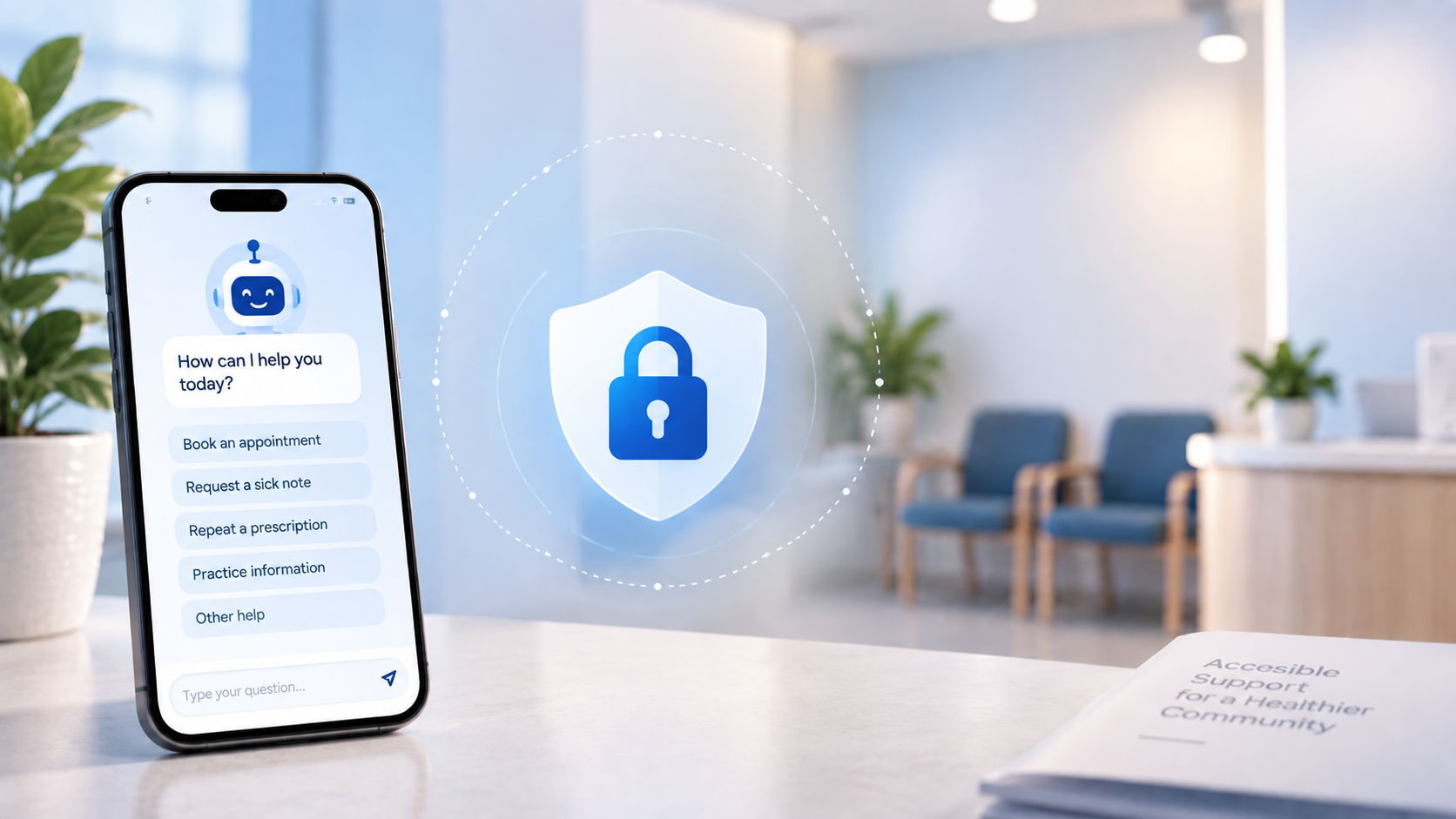
Artificial intelligence is creating new opportunities to make primary care more accessible, responsive and easier to navigate.
But as the use of AI in primary care grows, so does an important concern:
What happens to patient data?
For GP practices considering AI, questions around privacy are entirely relevant. Healthcare information can be highly sensitive, and patients need confidence that digital services are not asking them to disclose information unnecessarily.
But there is an important distinction that can sometimes get lost in conversations about healthcare AI privacy:
Not every patient interaction requires personal patient data.
Sometimes a patient simply wants to ask a question, understand what services are available or find the right route to support.
And when personal information isn’t necessary to achieve that purpose, there is a strong case for not asking for it in the first place.
This is where patient privacy in healthcare AI becomes not only a compliance issue, but an important part of creating a trustworthy digital patient experience.
Does Every Healthcare AI Tool Need Patient Data?
Consider some of the everyday questions patients ask their GP practice:
- How do I request a repeat prescription?
- How can I book an appointment?
- When is the practice open?
- How do I request a sick note?
- What services are available?
- How do I access a particular type of support?
- Where can I find information about referrals or test results?
Many of these questions are fundamentally about navigation and information.
A patient looking for the practice’s opening hours, for example, shouldn’t need to provide detailed health information simply to get an answer.
Similarly, someone trying to understand how to request a prescription may initially need information about the process rather than personalised clinical advice.
That creates an important distinction between:
Helping someone navigate healthcare information
and
Using an individual’s personal or clinical information to provide personalised support.
These are not the same thing.
A responsible approach to AI and patient data should therefore begin with a simple question:
What information does the system actually need to help this person?
What Is Data Minimisation in Healthcare AI?
This idea is closely connected to an established UK data protection principle: data minimisation.
Under UK GDPR, personal information should be adequate and relevant to its purpose and limited to what is necessary.
The Information Commissioner’s Office (ICO) explains that organisations should identify the minimum amount of personal information required to fulfil their purpose and process only that information.
That principle remains relevant when artificial intelligence is involved.
The ICO’s AI guidance specifically states that organisations using AI still need to comply with data-minimisation requirements. If an organisation can achieve its intended outcome by processing less personal information, it should consider doing so.
In simple terms:
Don’t collect information simply because you can. Consider whether you actually need it.
For healthcare AI, that principle is particularly important.
Why Patient Data Requires Particular Care
Healthcare data isn’t ordinary information.
Under UK GDPR, data concerning a person’s health is special category data, meaning it receives additional protection because of its sensitive nature.
The ICO emphasises that when special category data is involved, organisations need to pay particular attention to collecting and retaining only the minimum amount required.
This makes the relationship between AI and patient data particularly important for healthcare organisations.
A useful AI system isn’t necessarily one that knows everything about a patient.
For some purposes, the better system may be one that can provide useful support without needing to know who the patient is at all.
For other purposes, personal or clinical information may genuinely be necessary.
The key is understanding the difference.
AI and Patient Data: Asking the Right Question
When organisations evaluate healthcare technology, the first question is often:
What can this technology do?
But from a patient privacy perspective, another question is equally important:
What information does it need to do it?
Imagine two different interactions.
A patient asks:
“What time does my GP practice close today?”
There may be no reason for the system to know that patient’s medical history.
Now consider:
“Has my medication changed since my last consultation?”
That is an entirely different type of request. Answering it would potentially involve authorised access to personal clinical information and therefore raises substantially different questions around identity, permissions, security, clinical safety and governance.
Both interactions might involve AI.
But they should not necessarily involve the same amount of patient information.
That’s why data minimisation in healthcare AI matters.
Privacy Should Be Part of the Design
Patient privacy shouldn’t simply be something addressed in a privacy policy after a digital healthcare service has been developed.
It should influence how the service is designed.
For organisations considering AI in general practice, useful questions include:
Purpose: Why does the system need this information?
Necessity: Is the information actually required to complete the task?
Transparency: Does the patient understand what information is being processed and why?
Security: How will personal information be protected?
Retention: Does the information need to be retained, and for how long?
Access: Who can access the information?
Governance: Who is accountable for how the system processes patient information?
These considerations reflect wider UK data-protection principles, including purpose limitation, data minimisation, storage limitation, security and accountability.
The ICO also recommends considering data minimisation throughout AI system development rather than treating it as a one-off exercise.
Why Patient Privacy Matters in NHS Primary Care
Trust is fundamental to healthcare.
Patients share information with healthcare professionals that they may not share anywhere else.
As primary care becomes increasingly digital, maintaining that confidence becomes essential.
NHS England’s guidance on information governance for GP electronic patient records states that patient information should be used appropriately and processed and stored securely. It also emphasises transparency so patients can understand what their information is used for, why it is used and how it is used.
This is why the conversation around AI privacy concerns in NHS primary care shouldn’t simply be framed as a barrier to innovation.
Privacy can also be part of good innovation.
Patients may be more comfortable using a digital service when they understand what it does, what information it requires and why.
How GP Chatbot Approaches Patient Privacy
At GP Chatbot, AiLeen is designed to help patients navigate primary care through conversational AI.
Patients may want to understand how to access a practice service, find relevant information, identify an available pathway or simply understand where to go next.
For interactions where personal details aren’t necessary, the principle is straightforward:
Patients shouldn’t have to provide unnecessary personal information simply to ask a question or find out what support is available.
This is an important distinction.
Helping someone navigate general practice information is different from accessing and interpreting that person’s clinical record.
The latter introduces a substantially different set of considerations around authentication, authorisation, lawful processing, information governance, security and clinical safety.
For everyday informational support, however, a useful starting question is:
How little personal information do we actually need to help the patient?
That is a more privacy-conscious way to think about conversational AI in primary care.
Privacy Doesn’t Mean Healthcare AI Can Never Use Patient Data
There’s another important distinction.
Data minimisation doesn’t mean processing no personal information at all.
The ICO explicitly explains that the principle means processing the personal information necessary for a defined purpose, not avoiding personal information altogether.
There will be healthcare use cases where appropriately authorised access to patient information could be valuable.
In our recent discussion about the future of record-aware AI, for example, we explored what could eventually happen if appropriately governed healthcare AI were able to understand relevant clinical context.
That could potentially create much more personalised forms of support.
But greater personalisation also brings greater responsibility.
The question shouldn’t be:
“Should healthcare AI use patient data: yes or no?”
A better question is:
“What information is necessary for this specific purpose, and what protections should surround its use?”
Balancing Personalisation and Patient Privacy
This is likely to become one of the most interesting challenges in the future of AI in primary care.
On one side is personalisation.
Giving an AI system appropriate context could potentially enable it to provide more relevant support.
On the other side is privacy.
Greater context can mean processing more information about an individual.
Responsible healthcare AI needs to find the appropriate balance.
For a general question about how to access a GP service, personal clinical information may not be necessary.
For a future authorised system helping a clinician understand recent changes in a patient’s record, relevant clinical information might be essential to the purpose.
Different tasks require different levels of information and different safeguards.
That’s why patient data protection should be considered at the level of the specific use case rather than treating every healthcare AI interaction as though it were the same.
Patient Privacy Can Improve the Digital Experience
Privacy is sometimes discussed primarily in terms of compliance.
But it also affects patient experience.
Imagine being asked for your:
- full name,
- date of birth,
- address,
- NHS number,
- and medical information
before being allowed to ask a simple question about how a practice service works.
Even where an organisation has legitimate reasons for requesting information, unnecessary friction can make digital healthcare feel intrusive.
When identification isn’t necessary, reducing unnecessary requests for information can make the experience simpler.
The patient asks a question.
The system helps them find the relevant information.
And the interaction doesn’t require additional personal information simply for the sake of collecting it.
That can support both accessibility and trust.
Building Trust in AI in General Practice
The long-term adoption of healthcare AI won’t depend only on what the technology can do.
It will also depend on whether patients and healthcare professionals trust how it works.
That trust is built through responsible choices:
Collect information for clear purposes.
Only use what is necessary.
Explain what is happening.
Protect information appropriately.
Maintain appropriate human oversight.
And distinguish between interactions that genuinely require patient information and those that don’t.
The ICO’s current AI guidance stresses that organisations should assess and manage the data-protection and security implications of AI systems carefully.
For healthcare organisations, those principles become particularly significant because of the sensitivity of the information involved.
Better Digital Healthcare Shouldn’t Mean Giving Up Privacy
AI has considerable potential to improve how patients interact with primary care.
It can make information easier to find, provide support outside traditional opening hours and create more conversational ways for patients to navigate healthcare services.
But convenience alone isn’t enough.
Patients should also be confident that digital services are thoughtful about the information they request.
Sometimes personal information will genuinely be required.
Sometimes it won’t.
Knowing the difference is an important part of responsible healthcare AI.
The goal isn’t simply to collect more data so AI can do more.
It is to use the right information, for the right purpose, with the right protections and no more than necessary.
Because better digital healthcare isn’t just about convenience.
It’s about building trust.